For years, businesses have talked about reputation as if it were something that belonged to the communications department.
A company did the work.
Marketing built the brand.
Public relations protected the reputation.
I think that distinction is becoming obsolete.
Reputation is increasingly being created by almost everything an organisation does.
How it treats customers.
How its leaders behave.
What employees say about working there.
How it uses artificial intelligence.
How transparent it is when something goes wrong.
Whether its products live up to their promises.
Whether its governance deserves confidence.
Whether there is a gap between what the organisation says and what people actually experience.
And the more I study companies, the more I think we need a different way of understanding all of this.
I think reputation is becoming a form of capital.
What I mean by Reputation Capital
My working definition is simple:
Reputation Capital is the accumulated trust, credibility and confidence surrounding an organisation that influences the willingness of stakeholders to engage with it.
That engagement can take many forms.
A customer buys.
A talented executive joins.
An employee stays.
A supplier extends confidence.
An investor provides capital.
A partner enters a relationship.
A journalist gives the company a fair hearing.
A regulator believes management is acting responsibly.
A community permits the company to operate.
And when something goes wrong, stakeholders decide whether the failure represents an exception—or confirmation of what they already believed.
Reputation therefore does not sit outside the economic life of a company.
It participates in it.
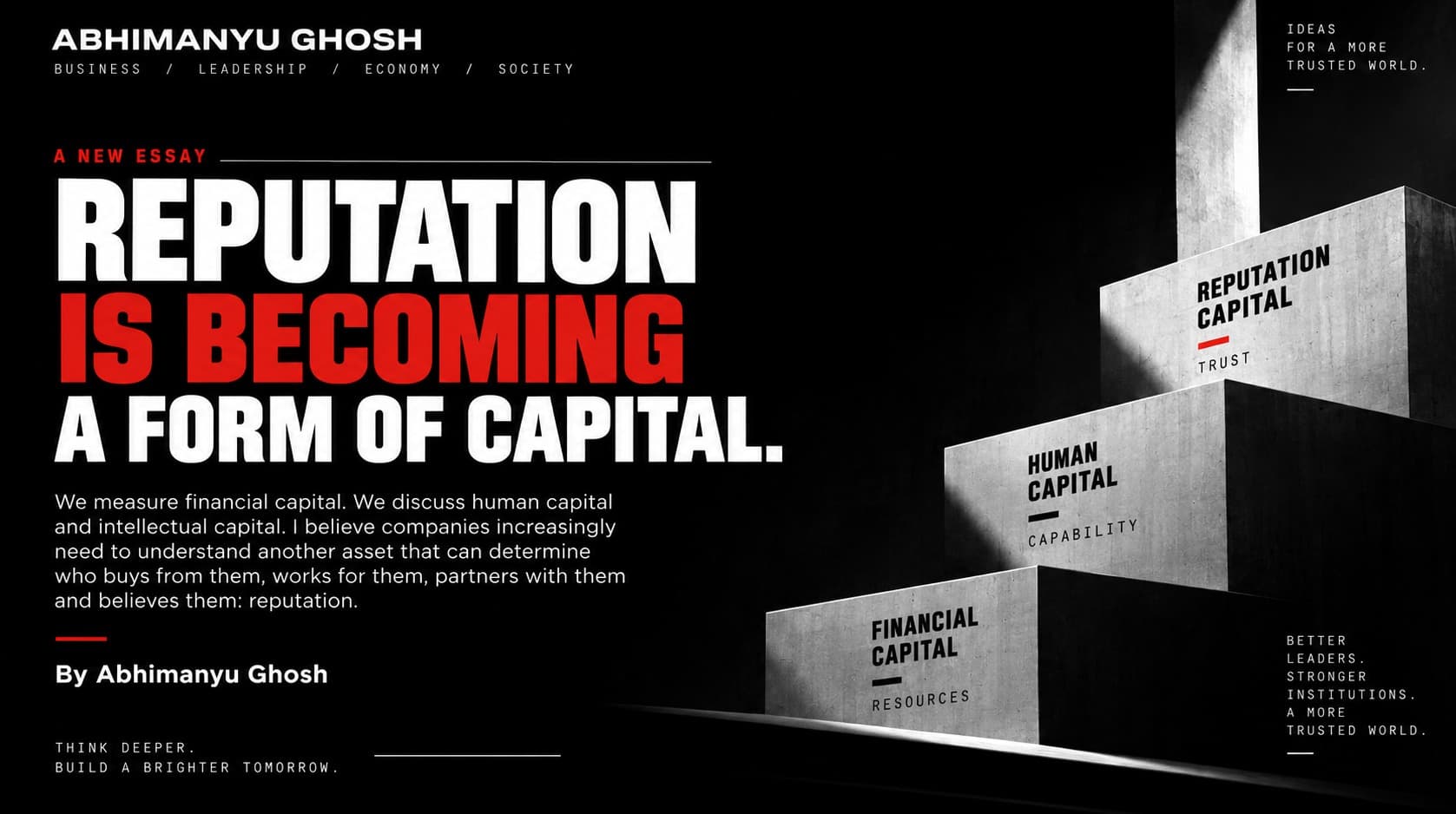
Financial capital gives you resources. Reputation Capital gives you permission.
Every company understands financial capital.
Without enough of it, the organisation cannot invest, hire, acquire, build or survive.
Companies increasingly talk about human capital too—the skills, intelligence, experience and capability within the organisation.
We also speak about intellectual capital: technology, knowledge, processes and proprietary ideas.
Reputation behaves differently, but it can still create economic advantage.
A company with strong Reputation Capital may find it easier to launch something new because customers are willing to try it.
A respected employer may have an advantage in attracting talent.
A trusted corporate brand may enter another market with less scepticism.
A credible CEO may persuade stakeholders to remain patient through a difficult transformation.
An organisation with decades of trust may survive a temporary crisis that would destroy confidence in a company with no reservoir of credibility.
Financial capital allows a company to act.
Human capital determines its ability to execute.
Reputation Capital affects how willing other people are to believe in those actions.
That is why I think it deserves much more attention from CEOs.
Trust is already affecting commercial behaviour
This is not simply a philosophical argument.
Recent global research shows how commercially important trust has become.
Edelman's 2026 global brand research found that 88% of consumers considered trusting a brand important or critical when deciding whether to buy it—almost exactly the same level as product quality and value. Edelman
Think about what that means.
Businesses have always understood two fundamental questions:
Is our product good enough?
Is the customer receiving enough value?
There is increasingly a third:
Does the customer trust us?
Trust can affect trial, retention, recommendation and willingness to follow a company into a new product or category.
It can therefore influence growth—not simply crisis management.
PwC's 2026 CEO research offers another interesting signal. Two-thirds of CEOs surveyed reported meaningful stakeholder trust concerns during the previous year. Among public companies in its sample, those experiencing the fewest trust concerns produced average 12-month shareholder returns nine percentage points higher than those experiencing the most. PwC correctly treats this as a relationship rather than proof that trust alone caused superior returns. PwC
I think that distinction is important.
The argument should not be:
Good reputation automatically creates a higher share price.
The more useful question is:
What is different about organisations that consistently produce both trust and strong performance?
Perhaps reputation is frequently evidence of something deeper.
Reputation may be the visible consequence of institutional quality
Consider two companies.
Both spend heavily on advertising.
Both produce polished annual reports.
Both talk about innovation.
Both issue statements about customers, employees and responsibility.
But one actually delivers.
Its product works.
Its leadership is credible.
Its employees trust management.
Its governance is serious.
Customers receive good service.
When management makes a mistake, it acknowledges it.
The second company communicates many of the same values—but stakeholders repeatedly experience something different.
Over time, the first company accumulates trust.
The second accumulates scepticism.
This is why I increasingly believe reputation is not principally a communications output.
It is an organisational output.
A great communications team can help people understand the reality of an organisation.
It cannot indefinitely overcome the wrong reality.
Your brand is increasingly what the organisation does
This has significant consequences for how we think about brands.
Companies often ask:
How should we position our brand?
It is an important question.
But increasingly I think another should come first:
What does our organisation repeatedly do that gives people a reason to believe that positioning?
If the two answers are inconsistent, there is a problem.
A company cannot sustainably position itself around customer obsession while treating customers badly.
It cannot position itself around innovation while punishing experimentation internally.
It cannot build an employer brand around wellbeing while its management culture creates burnout.
It cannot claim transparency while leadership avoids accountability.
It cannot promise responsible AI while nobody can explain how automated decisions are governed.
The brand promise and organisational reality are eventually reconciled by stakeholders.
And increasingly, stakeholders possess the tools to do the reconciliation themselves.
Companies no longer control their own stories
This may be one of the most important changes of the digital era.
Corporations once had considerable control over the information surrounding them.
Advertising spoke to customers.
PR spoke to the media.
Annual reports spoke to investors.
Internal communications spoke to employees.
Today the company is only one participant.
Employees publish on LinkedIn.
Customers review products publicly.
Former employees describe workplace culture.
Executives develop their own audiences.
Researchers analyse companies.
Investors exchange information instantly.
Communities organise.
Journalists can draw on enormous quantities of public data.
And increasingly, AI systems synthesise information from all of them.
RepTrak describes the 2026 reputation environment as increasingly “multiplayer”, shaped by customers, employees, communities, creators and AI rather than top-down corporate messaging alone. Its reputation framework measures not only products and performance but workplace, conduct, citizenship and leadership. RepTrak
That is a fundamental shift.
A company can still influence its reputation.
But it cannot simply author it.
AI may make genuine reputation even more important
Artificial intelligence adds another dimension.
For many people, the first answer they receive about a company may increasingly come from an AI system.
Ask:
“Is this a good company to work for?”
“Can I trust this brand?”
“Who owns this business?”
“What controversies has this company faced?”
“Is this CEO respected?”
“What do customers say about this product?”
The answer may combine information from corporate websites, news coverage, employee discussions, customer reviews, research, public filings and countless other sources.
RepTrak incorporated generative AI as a discrete reputation touchpoint in its global measurement for the first time in 2026. RepTrak
This creates a profound challenge for companies.
You can optimise corporate content.
But you cannot fully control what the wider information environment says about you.
That means the ultimate defence may be remarkably old-fashioned:
actually deserve the reputation you want.
The rise of Reputation Debt
This leads to another concept I think companies should pay attention to.
I call it Reputation Debt.
Reputation Debt is the accumulating gap between:
what an organisation promises
and
what its stakeholders experience.
Companies can operate with Reputation Debt for surprisingly long periods.
Strong advertising can hide a mediocre customer experience.
A charismatic founder can compensate for weak governance.
Rapid financial growth can distract from cultural problems.
Brand heritage can protect an organisation after its relevance has begun deteriorating.
PR can contain isolated incidents.
But debt compounds.
Every contradiction adds something.
Every unkept promise adds something.
Every leadership inconsistency adds something.
Eventually a trigger arrives—a crisis, a bad product, an employee controversy, a governance failure, a data breach.
The immediate event receives all the attention.
But sometimes the reputational collapse is much larger than the event because stakeholders are not reacting only to what happened yesterday.
They are collecting on years of accumulated Reputation Debt.
Reputation is increasingly built from the inside out
Employee reputation is particularly important.
People know more about their employers than almost any other stakeholder knows about a company.
Employees know whether the stated values are real.
They know how leaders behave when nobody outside the company is watching.
They know how promotions happen.
They know whether performance is rewarded.
They know how customers are discussed internally.
They know whether management tells employees the truth.
And today, those experiences do not remain inside the company.
Employer trust remains particularly strong relative to many other institutions, making the employer relationship an unusually valuable source of credibility. That gives organisations an opportunity—but it also means employee trust is an asset that can be damaged.
This is one reason I think the traditional separation between employer brand and corporate brand will become increasingly difficult to maintain.
The outside world eventually discovers something about the inside world.
The CEO has become part of corporate reputation
Leadership creates another convergence.
There was a time when many CEOs could lead very large companies while remaining relatively unknown outside their industry.
That is increasingly difficult.
CEOs speak publicly.
They appear on television.
They publish on LinkedIn.
They speak at conferences.
Their interviews are clipped and redistributed.
Employees discuss them.
Investors assess them.
Their decisions become part of the brand.
A CEO can therefore add Reputation Capital to an organisation.
Credibility.
Clarity.
Competence.
Consistency.
Judgment.
But leadership can also consume Reputation Capital.
When the company's reputation becomes excessively dependent on one individual, personal reputation risk becomes corporate risk.
This is especially important for founder-led organisations.
The founder may initially be the company's greatest reputational asset.
But an institution must eventually develop reputation that exists independently of any one person.
That connects directly to another idea I keep returning to:
The Founder Is Not the Institution.
Governance is no longer invisible
One of the reasons reputation is reaching board level is that governance itself has become reputational.
Oxford and GlobeScan's 2026 survey of senior corporate-affairs practitioners found governance had overtaken environmental and social issues as the leading ESG-related reputational concern. Respondents increasingly pointed toward ethics, transparency, regulatory compliance and board oversight. GlobeScan
That makes sense.
Governance determines who is accountable.
Governance determines who can challenge the CEO.
Governance determines how conflicts are handled.
Governance determines whether bad information reaches decision-makers.
Governance determines what happens after failure.
These decisions may begin inside the company.
Their consequences can become highly public.
In that sense:
governance is reputation before reputation becomes visible.
AI is turning trust into a management problem
The same principle applies to AI.
Companies are racing to introduce artificial intelligence into customer service, recruiting, workflows, financial analysis, decision-making and products.
But public trust remains limited.
Gallup found in 2026 that only 27% of Americans said they trusted businesses at least somewhat to use AI responsibly, falling to 20% among adults under 30. Gallup.com
Meanwhile, Oxford-GlobeScan found that although corporate-affairs executives overwhelmingly see AI as a major opportunity, only 18% said their organisations were fully prepared for AI-generated misinformation and deepfakes. GlobeScan
The reputation questions created by AI cannot be answered by marketing.
They require decisions about:
data,
privacy,
security,
human oversight,
bias,
accountability,
transparency,
and governance.
Once again, reputation becomes an operating issue.
Crisis reveals the Reputation Capital already accumulated
The value of Reputation Capital may become most visible when something goes wrong.
Imagine two companies experience similar failures.
Company A has spent years treating customers fairly, communicating transparently and operating credibly.
Company B has accumulated complaints, contradictions and scepticism.
The identical incident may produce very different stakeholder responses.
For Company A:
“Something has gone wrong. Let's see how they handle it.”
For Company B:
“This proves what we always suspected.”
Strong reputation does not excuse failure.
It should never provide immunity.
But accumulated trust may determine how stakeholders initially interpret uncertainty.
That is extraordinarily valuable in a world where crises move faster than complete information.
Reputation Capital cannot simply be purchased
This is where companies need discipline.
Advertising can be purchased.
Visibility can be purchased.
Sponsorship can be purchased.
Media distribution can be purchased.
Events can be purchased.
Professional communications can be purchased.
But trust itself cannot sustainably be bought.
There must be an underlying reason for stakeholders to give it.
This distinction is particularly important to me because of WCRC's work.
Independent research, scoring, rankings, qualification and recognition must remain independent of commercial participation.
If companies could buy the research conclusion, the conclusion would eventually have no reputation.
The credibility of recognition depends on something larger than the recognition itself:
trust in the institution producing it.
The same principle applies to companies.
Reputation becomes economically useful precisely because people believe it has been earned.
The management question is therefore changing
Companies traditionally asked:
How do we manage our reputation?
I think boards and CEOs should increasingly ask:
How does this company create trust?
Those are different questions.
The first often begins after a problem.
The second begins before decisions are made.
It affects:
product quality,
customer service,
executive behaviour,
employee experience,
corporate governance,
AI deployment,
cybersecurity,
pricing,
acquisitions,
restructuring,
market entry,
and succession.
Reputation strategy therefore belongs before the decision, not merely after it.
What I would measure
I do not think reputation can be captured adequately by one simplistic number.
But I do think organisations need a clearer picture of the different forms of trust surrounding them.
I would want to understand at least:
Customer Trust
Do customers believe the organisation will consistently deliver?
Leadership Trust
Do stakeholders believe management is credible?
Workplace Reputation
Does employee experience reinforce or contradict the corporate narrative?
Governance Confidence
Do stakeholders believe the organisation is responsibly overseen?
Digital Trust
Are technology, data and AI being handled responsibly?
Brand Trust
Are people willing to recommend and follow the company into something new?
Reputation Resilience
What happens to trust when the organisation fails?
Looked at together, these questions create a much richer picture than media sentiment alone.
India has a particular opportunity
For Indian companies, I think this matters enormously.
India is producing businesses of extraordinary scale.
Technology companies.
Consumer businesses.
Conglomerates.
Startups.
Manufacturers.
Global capability centres.
Financial institutions.
Digital platforms.
The ambition now extends far beyond India.
But becoming a global business and becoming a globally trusted business are not the same achievement.
Global brands require more than products.
They require confidence.
International customers need to trust quality.
Employees need to trust leadership.
Partners need to trust commitments.
Regulators need to trust governance.
Investors need to trust disclosure.
Communities need to trust behaviour.
India's next generation of international companies may therefore need to export something alongside products, services and technology:
trust.
And that may become one of the largest brand-building opportunities of the coming decade.
Reputation Capital is not about looking good
This distinction matters most.
Reputation Capital is not about becoming admired through better publicity.
It is about becoming an organisation that gives people repeated reasons to trust it.
That requires consistency between:
promise and experience,
leadership and behaviour,
brand and organisation,
ambition and responsibility.
The communications function can tell that story.
But the organisation has to live it first.
The idea I keep returning to
I increasingly think the strongest companies of the future will understand three different forms of capital.
Financial Capital
What resources do we possess?
Human Capital
What are we capable of doing?
Reputation Capital
Who trusts us enough to come with us?
That third question will become more important as information becomes abundant, AI makes corporate claims easier to investigate, employees become publishers, leadership becomes more visible and stakeholders become more demanding.
The traditional idea of reputation management is therefore too narrow.
Reputation is not simply something you protect.
It is something you accumulate.
Something you spend.
Something you can lose.
And something that can open doors unavailable to competitors.
Which is why I believe corporate reputation is evolving from an image problem into an economic asset.
And ultimately:
Reputation is becoming a form of capital.
Abhimanyu Ghosh
Business. Leadership. Economy. Society.
This essay develops my interpretation of the changing role of corporate trust and reputation. It is informed in part by contemporary research on corporate trust, brands, governance and reputation, as well as WCRC's ongoing work around companies, leaders and reputation.
Sources & Notes
- 2026 Edelman Trust Barometer Special Report: Brand Growth in an Insular World ↗ / Edelman
Consumer trust as a purchase criterion, alongside quality and value.
- How companies can compete on trust ↗ / PwC / 2026-02-20
29th Global CEO Survey; stakeholder trust concerns and the association with shareholder returns. The comparison does not establish causation.
- 2026 Global RepTrak ↗ / RepTrak
Reputation drivers, stakeholder participation and generative AI as a measured touchpoint.
- Oxford-GlobeScan Global Corporate Affairs Survey 2026 ↗ / GlobeScan / University of Oxford / 2026-07-20
Governance as an ESG-related reputation risk; preparedness for AI-generated misinformation and deepfakes.
- Americans Cool Toward AI ↗ / Gallup / 2026-07-28
Bentley-Gallup research on responsible business use of AI, including younger adults.