India has proved something extraordinary over the past decade.
We can create entrepreneurs.
Lots of them.
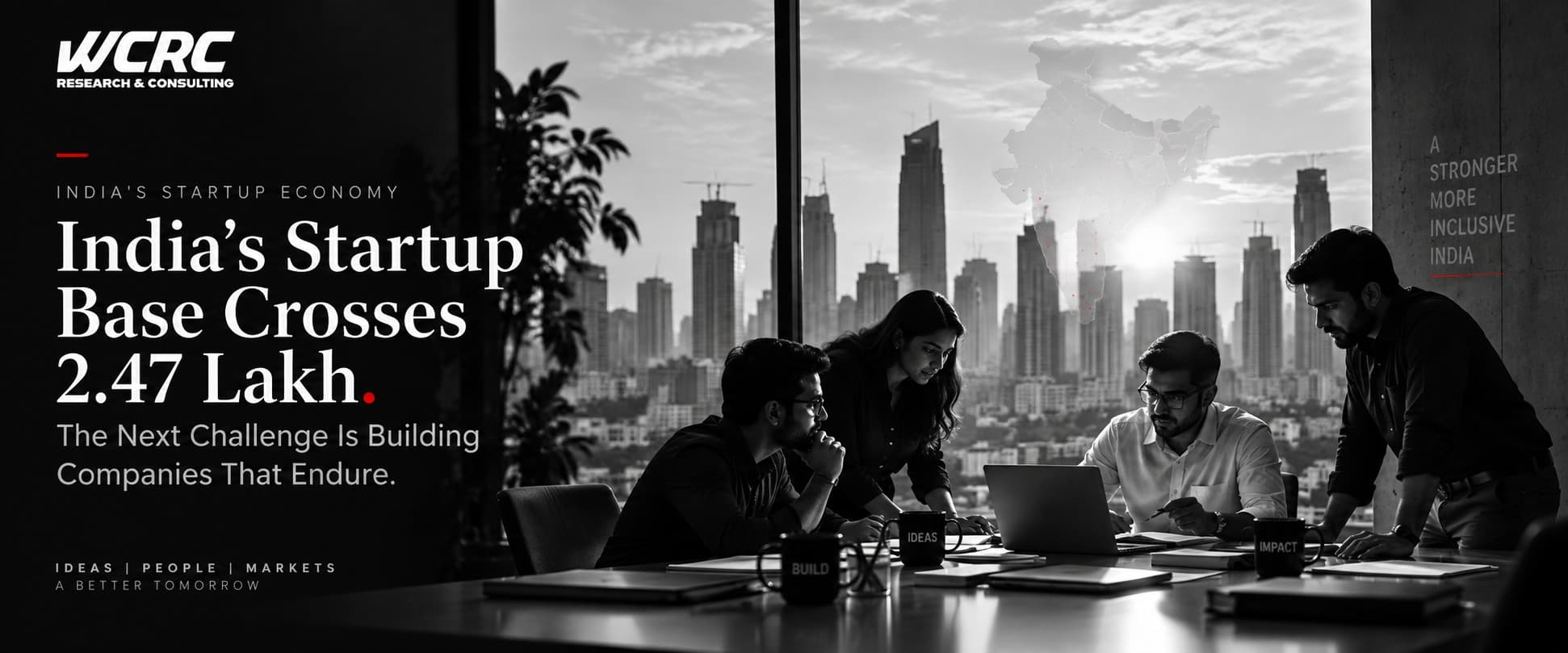
As of August 2026, India had more than 2.47 lakh DPIIT-recognised startups. By March, those businesses had generated more than 23.36 lakh direct jobs. More than half of India's startup activity is now reported to be emerging from Tier-II and Tier-III cities.
I think the next question is much more important than whether we can take that number from 2.47 lakh to five lakh.
It is this:
How many of these startups will become institutions?
Because creating a startup and building an enduring company are not the same thing.
And building an institution is harder still.
We have become very good at celebrating beginnings
Startup culture naturally celebrates beginnings.
The idea.
The founder.
The funding announcement.
The first million users.
The new valuation.
The unicorn.
These moments matter. Entrepreneurship needs optimism.
But companies are not ultimately built by beginnings.
They are built by what happens afterwards.
Can the company retain customers?
Can it make money?
Can it recruit people better than the founder?
Can decisions be made without everything travelling through one office?
Can the organisation survive a bad year?
Can it survive a funding winter?
Can it survive the departure of key executives?
And eventually:
Can it survive its own founder?
That is when the startup question becomes an institution question.
A founder can build a company. A founder cannot be the company forever.
Founders are often the reason a startup exists.
Their obsession can be enormously productive in the early years.
The founder understands the customer.
The founder sets the pace.
The founder recruits believers.
The founder takes decisions other people would consider irrational.
Without that intensity, many great companies would never exist.
But somewhere in the life of an organisation, the characteristic that created the company can become the characteristic preventing it from becoming an institution.
If every important decision still requires the founder, the company has scaled revenue without scaling leadership.
If talented executives cannot disagree with the founder, the company has hired senior people without creating senior management.
If culture means doing what the founder would do, the company has personality but not necessarily institutional culture.
If the business collapses when the founder leaves, what existed was an extraordinary founder-led company—not yet an enduring institution.
I believe India is approaching this transition at enormous scale.
Capital is already demanding more
The venture market appears to be moving in the same direction.
Indian technology startups raised around $7.2 billion in the first half of 2026, 12% more than a year earlier. But the number of funding rounds fell 43% to 652.
That is interesting.
More money. Fewer deals.
The capital market appears increasingly willing to fund companies it believes in deeply—and increasingly unwilling to fund every credible story.
Public markets are applying even greater discipline. Investors are focusing much more closely on profitability, cash flow, governance, operating leverage and sustainable economics than during the startup euphoria of 2021.
I think this is healthy.
A startup ecosystem does not become mature when capital becomes easy.
It becomes mature when capital becomes intelligent.
We should stop measuring entrepreneurship only through startup counts
The 2.47 lakh number is an extraordinary achievement.
But imagine the questions we could ask next.
How many Indian startups survive for ten years?
How many build ₹1,000 crore businesses?
How many employ 10,000 people?
How many become global exporters?
How many create brands recognised across continents?
How many professionalise successfully?
How many create second-generation leadership?
How many develop succession systems?
How many founders can eventually walk away for a month and discover the business has become stronger rather than weaker?
Those numbers would tell us something different.
They would tell us whether we are not just creating entrepreneurs—but building institutions.
The journey is not Startup → Unicorn
I would think about the company-building journey differently.
Stage 1: Idea
Somebody sees an opportunity.
Stage 2: Startup
The founder proves that somebody cares.
Stage 3: Scalable business
The organisation discovers how to grow repeatedly.
Stage 4: Company
Management, systems, economics and accountability become real.
Stage 5: Institution
The organisation becomes capable of adapting, renewing itself and creating value beyond one generation of leadership.
Very few companies reach the final stage.
That is exactly why institutions are valuable.
Tata is not interesting simply because of the size of its businesses.
It is interesting because more than a century of leadership changes, economic cycles, technological disruptions and competitive shifts have not eliminated the institution.
The same question can be asked of Toyota, Microsoft, P&G or many other enduring organisations.
What exists inside these companies that survives the people who built them?
That is one of the business questions I intend to keep studying.
Tier-II India makes this even more consequential
More than half of India's recognised startups are now reported to emerge from Tier-II and Tier-III cities.
That could fundamentally change the geography of Indian entrepreneurship.
But I don't think the objective should simply be to replicate Bengaluru everywhere.
The opportunity is much bigger.
An entrepreneur in Jaipur may understand a market differently from someone in Bengaluru.
A founder in Coimbatore may see a manufacturing opportunity invisible to a consumer-technology founder.
A business in Indore, Kochi, Bhubaneswar, Surat or Lucknow may solve problems rooted in completely different economic ecosystems.
India needs those different entrepreneurs.
The country also needs them to develop the surrounding ecosystems that make durable businesses possible:
capital,
universities,
talent,
experienced managers,
professional advisers,
supplier networks,
and customers willing to buy from young companies.
Startup activity becoming national is good.
Company-building capability becoming national would be transformative.
India also needs more brands
There is another part of this conversation that I believe India sometimes underestimates.
Companies can grow very large without creating powerful brands.
But globally influential companies generally develop something deeper than distribution and scale.
They earn trust.
They create meaning.
Customers understand what they stand for.
Talented people want to work for them.
Partners want to be associated with them.
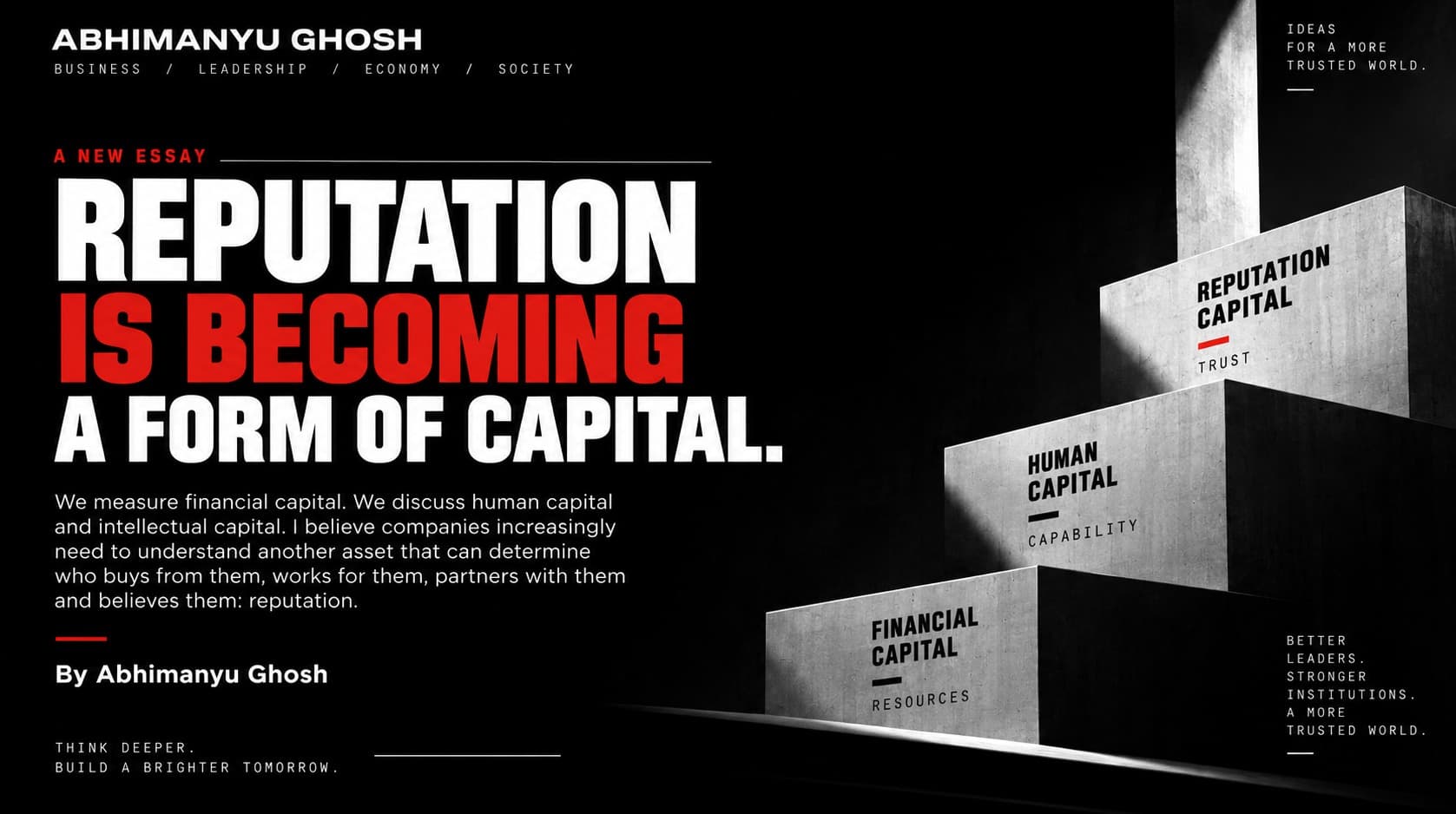
That is why I increasingly think about Reputation Capital as something economically meaningful.
A business can possess financial capital, intellectual capital and human capital.
It can also accumulate trust.
And trust affects what stakeholders are willing to do with the company.
India's startup story therefore cannot stop at valuation.
We need more businesses that become brands, and more brands that become institutions.
The best founders eventually make themselves less essential
There is a paradox in entrepreneurship that fascinates me.
At the beginning, the founder must make themselves indispensable.
At scale, perhaps the founder's greatest achievement is doing the opposite.
The organisation should gradually become capable of making important decisions without depending on one person.
Strong people should emerge.
Systems should improve.
Culture should acquire its own logic.
Governance should become credible.
The brand should belong to the company rather than the individual.
A founder who accomplishes this has achieved something much larger than control.
They have created institutional continuity.
The next decade should be about depth
India's first startup decade gave us breadth.
Hundreds of thousands of ventures.
Millions of jobs.
Entrepreneurs across the country.
More women participating.
More capital.
More technology.
More ambition.
The next decade should give us depth.
Better management.
Better governance.
Better economics.
Better workplaces.
Better brands.
Better succession.
Better institutions.
That is not as easy to celebrate as a funding announcement.
But twenty years from now, it will matter much more.
India has already demonstrated that it can create startups.
The more interesting question now is:
Can India become one of the world's great institution-building economies?
I think that is where the next chapter begins.
The idea in one sentence
The ultimate success of India's startup revolution will not be measured by how many startups the country creates, but by how many of them become enduring institutions.
This essay draws on current data from India's Department for Promotion of Industry and Internal Trade and on WCRC's companion analysis of India's startup ecosystem. The interpretation and views expressed here are my own.
Sources & Notes
- Building a Business-Ready India ↗ / Press Information Bureau / 2026-08-13
DPIIT recognition count as of 12 August 2026.
- Government recognizes more than 55,200 startups during FY 2025-26 ↗ / Ministry of Commerce & Industry / PIB / 2026-04-17
Recognition and direct employment figures as of 31 March 2026.
- RISE Conclave 2026: entrepreneurship beyond metropolitan centres ↗ / Press Information Bureau
Reported share of startups emerging from Tier-II and Tier-III cities.
- India tech funding rises 12 pc to $7.2 billion in H1 2026 ↗ / IANS / Investment Guru India / 2026-06-25
Reports Tracxn funding data for 1 January to 24 June 2026.