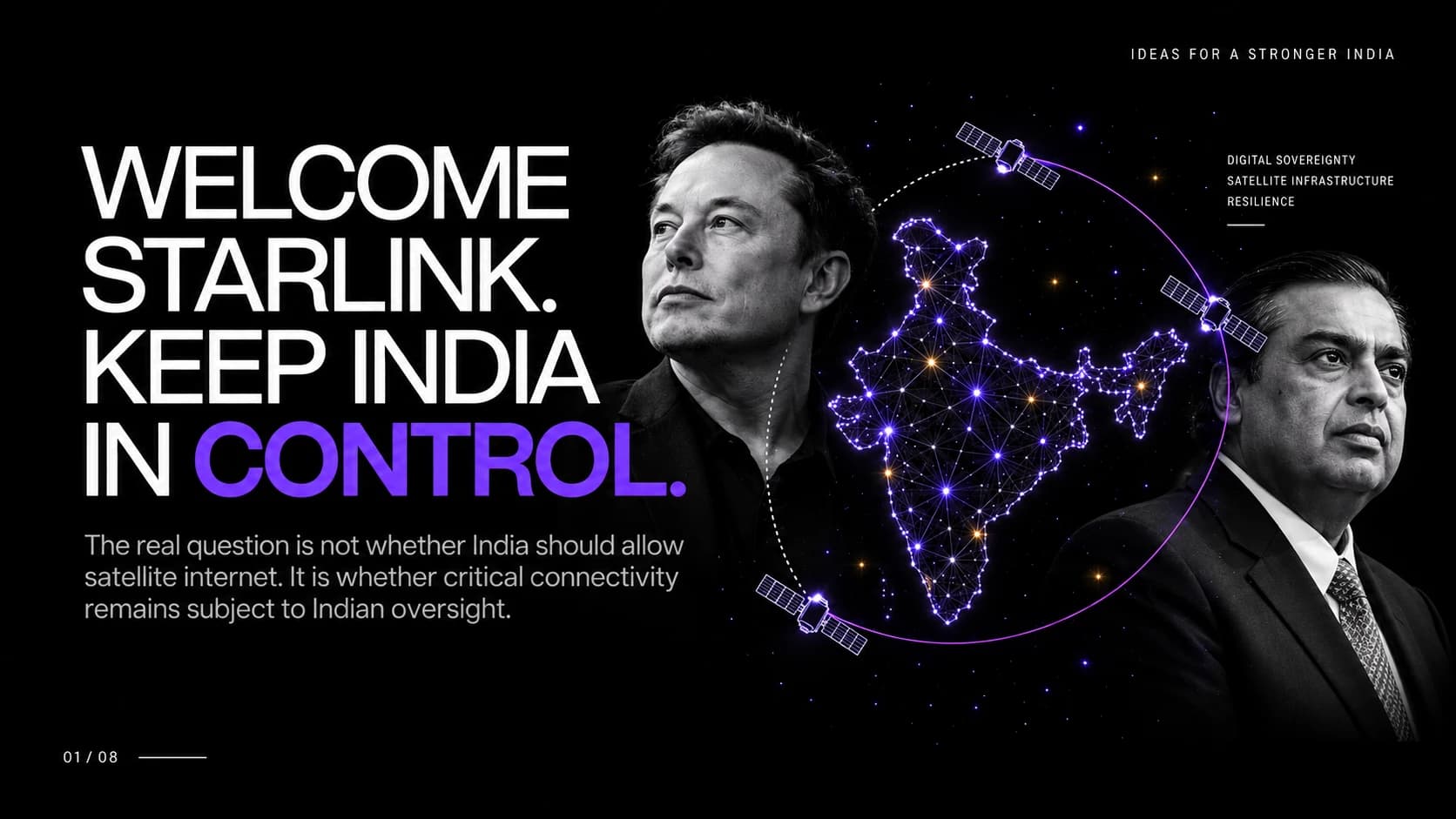
An illustrated essay in eight slides. The text from the supplied artwork is also presented below for reading and accessibility.
Welcome Starlink. Keep India in control.
The real question is not whether India should allow satellite internet. It is whether critical connectivity remains subject to Indian oversight.

This is bigger
Musk vs Ambani.
The real debate is how India balances open markets with control over strategically important communications infrastructure.

Satellite internet is strategic infrastructure
It can support border outposts, maritime operations, emergency response and remote regions far beyond consumer broadband.

The real questions India must ask
These are the sovereignty questions behind the Starlink debate.
- Who controls the network during a crisis?
- Can services be restricted from outside India?
- Can sensitive traffic bypass Indian infrastructure?
- Can Indian authorities independently verify compliance?
- What ensures continuity during emergencies?

What India should build first
Objective 1 and 2: indigenous constellations plus domestic hardware and software capability.
- Indigenous satellite constellations: Indian-designed broadband networks. Resilient backup systems.
- Domestic hardware and software: payloads, antennas, RF components, terminals, network management.

What India should build next
Objective 3, 4 and 5: direct-to-device capability, a sovereign space industry, and integrated national connectivity.
- Satellite-to-mobile connectivity: direct-to-device for 5G and future 6G.
- A sovereign space industry: manufacturing, launch, propulsion, secure ground systems.
- Integrated national connectivity: coordinate fibre, terrestrial telecom, satellite and cybersecurity.

Open markets. Indian oversight.
Every operator, domestic or foreign, should be subject to the same transparent rules.
Licensing. Spectrum. Gateways. Data protection. Cybersecurity. Lawful access. Emergency continuity.
The goal is not exclusion. It is to preserve Indian oversight and build national capability.

The answer is capability, not closure
India should welcome competition, avoid foreign dependence, avoid domestic monopoly, and build sovereign technological capability.
Keep markets open. Keep critical connectivity under Indian oversight.

Policy context and further reading
- Indian Space Policy 2023 ↗ / ISRO / 2023
Official policy context for India's space sector.
- Recommendations on spectrum for satellite-based commercial communication services ↗ / TRAI / 2025-05-09
TRAI's dated recommendations, provided as policy context; recommendations are distinct from final government rules.