I don’t need gaming to make me a better entrepreneur. Sometimes I just want to play.
That might seem like an odd place to begin a newsletter about business, leadership and trust. But it gets quite close to why I’m starting this.
I’m an entrepreneur, an avid gamer, a world traveller and a spiritual seeker. The business part usually comes first in an introduction. The rest gets added later, almost as an afterthought.
I don’t think of those parts of myself as afterthoughts.
I care about building businesses. Through WCRC, my work brings together companies, brands, leadership and reputation. I’m interested in how ideas become organisations, how organisations earn credibility, and what makes people believe in something enough to support it.
But I also want a life that has room for things with no commercial explanation.
And yes, I want this newsletter to reach people. I’m not pretending to be above ambition while building an audience. I want the ideas here to be useful, to start conversations and, where possible, to lead to something being done differently.
The question is how much of ourselves we hand over to the pursuit of success—and what we expect to get back.
A hobby doesn’t need to earn its place
There’s a version of this article in which I explain how gaming develops strategic thinking, travel builds cultural awareness and spirituality improves leadership.
There may be something worth exploring in each of those connections. But I’d rather not begin by making my interests apply for a job.
Sometimes I enjoy a game because it’s a game. I don’t need to turn the experience into a presentation on resilience afterwards.
Someone else might feel that way about gardening, cricket, cooking or singing badly when nobody is listening. Enjoyment seems a perfectly reasonable justification to me.
What bothers me is the expectation that everything should help us become more productive. Even time away from work can end up being judged by how much better we work when we return.
I’d like to leave some things outside that calculation.
Of course, gaming does give me things to think about. I’m interested in the willingness to be a beginner: to enter a world you don’t understand, get things wrong and gradually work it out. There’s no reason to pretend you’ve mastered something you only started yesterday.
That’s harder when you have a senior title.
Once people expect you to know the answer, admitting that you don’t can feel uncomfortable. I think there’s value in having something in your life where your designation gets you nowhere.
Still, the game doesn’t owe me that lesson. I’m allowed to enjoy it either way.
There are other ways to live
Travel is another part of my life I don’t want to reduce to a professional advantage.
I love discovering places. But what interests me just as much is the possibility of encountering a way of living I wouldn’t have imagined for myself.
You can understand, intellectually, that people see the world differently. It’s another thing to spend time somewhere your usual assumptions don’t get you very far.
What counts as polite? What deserves someone’s time? How much space does work occupy? What makes a good day?
I’m curious about those questions. They don’t always need an immediate answer, and certainly not a verdict about which culture has got everything right.
I want to remain interested in ways of living that I wouldn’t necessarily choose for myself.
That feels important beyond travel. In business, it’s easy to hear a different perspective only long enough to prepare a response. I’d like to get better at staying with it a little longer.
Spirituality takes that curiosity in a more personal direction.
I approach it as a seeker, not as someone with a set of answers to hand out. I’m interested in faith, gratitude, service and the difficult business of understanding yourself honestly.
Particularly when things are going well.
It’s easy to admire humility as an idea. The harder question is whether you can accept correction when you have the authority to dismiss it. Or help someone without needing the gesture to become part of your public identity.
I don’t think a person needs to share my spiritual interests to care about these things. What matters to me is how any belief—or principle—finds its way into ordinary behaviour.
I’d rather explore that than offer a polished account of inner balance. There’s enough certainty being sold already.
A wider life cannot be another assignment
There’s a difficulty here that deserves saying plainly: telling someone to enjoy life outside work is not much use when their working conditions leave no room for it.
Not everyone can take a long trip or set aside an uninterrupted weekend. People have financial responsibilities, families to care for and circumstances that don’t respond to inspirational advice.
So I don’t want “a wider life” to become another standard people feel they are failing to meet.
For those of us who lead organisations, the question comes back to the environment we create. Do people genuinely have time that belongs to them? Can they switch off without wondering whether it will be held against them?
A wellbeing message means very little when everyone knows they are expected to answer a routine email late on a Sunday.
That is where a personal conversation becomes a leadership responsibility.
Why a more trusted world?
Because trust makes these ideas practical.
In my work around brands and reputation, I keep coming back to the distance between what an organisation says and what people experience.
A company can describe itself beautifully. The customer still has to deal with it. An employee still has to work there. A supplier still has to find out whether its commitments mean anything.
To me, reputation is tested in those encounters.
Can someone raise a problem without becoming the problem? Does a promise still matter when keeping it becomes inconvenient? Will a leader acknowledge an error before somebody forces the issue?
These are questions about decisions, not image.
That’s the business conversation I want to have here: how we build companies that deserve confidence, rather than simply becoming more skilled at asking for it.
I’m interested in growth, innovation and influence. I’m equally interested in what supports them when the excitement fades and people start looking closely.
Being admired and being trusted are not necessarily the same achievement.
I’d like to spend more time examining the difference.
What I want to build here
Some editions of this newsletter will be firmly rooted in business: a company, a leadership decision, a question about reputation or an idea we are developing through WCRC.
Others may start with gaming, travel, spirituality or something outside work that has caught my attention. I won’t force a management lesson into every one of them.
The aim is to bring these parts of my life into the same conversation without pretending they always fit together neatly.
I want to discuss ideas that can change how we build and lead. I also want room to question what we are building towards. A larger business is a meaningful ambition. So is having the freedom to enjoy an ordinary evening without feeling you should be doing something more useful.
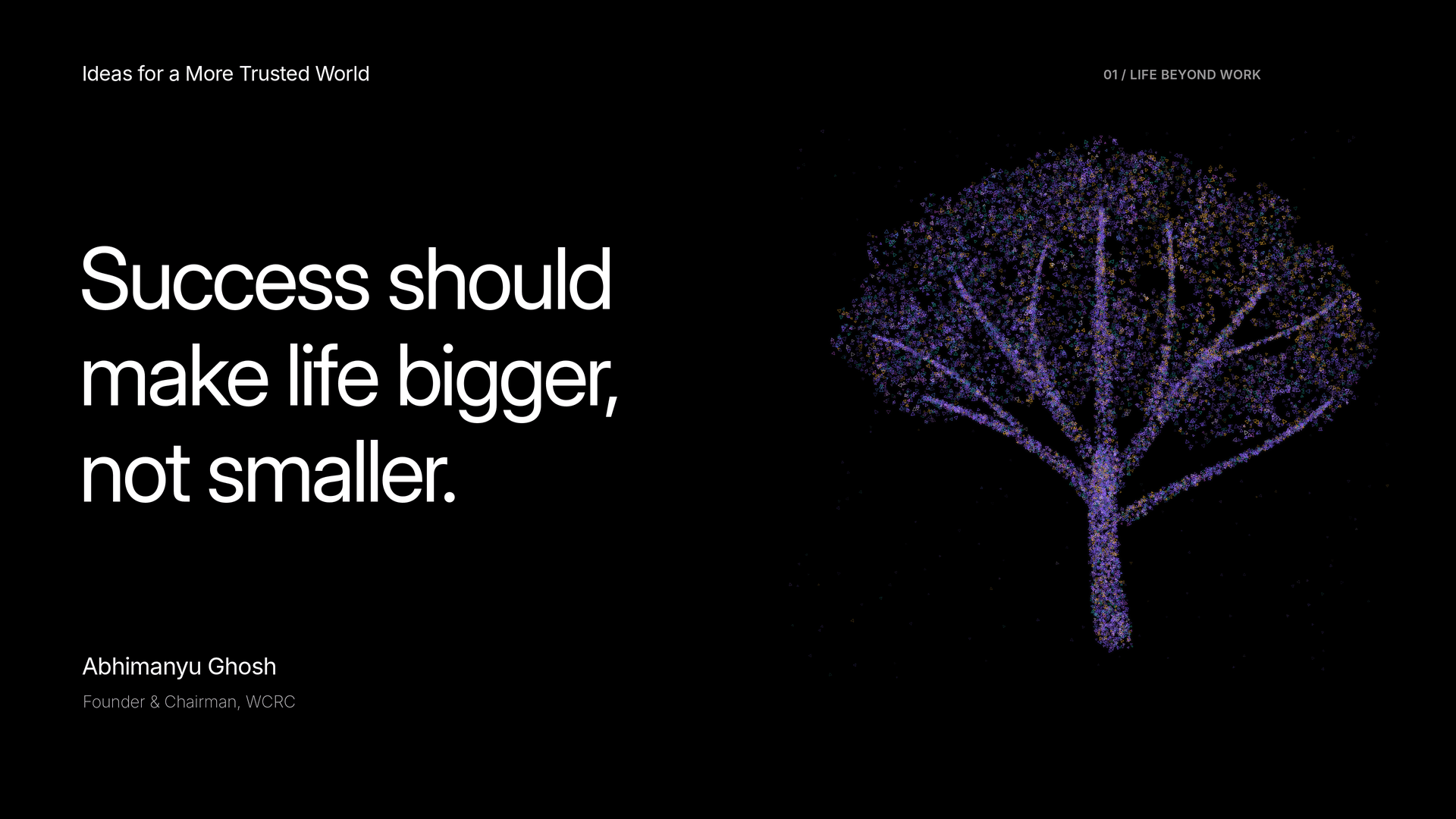
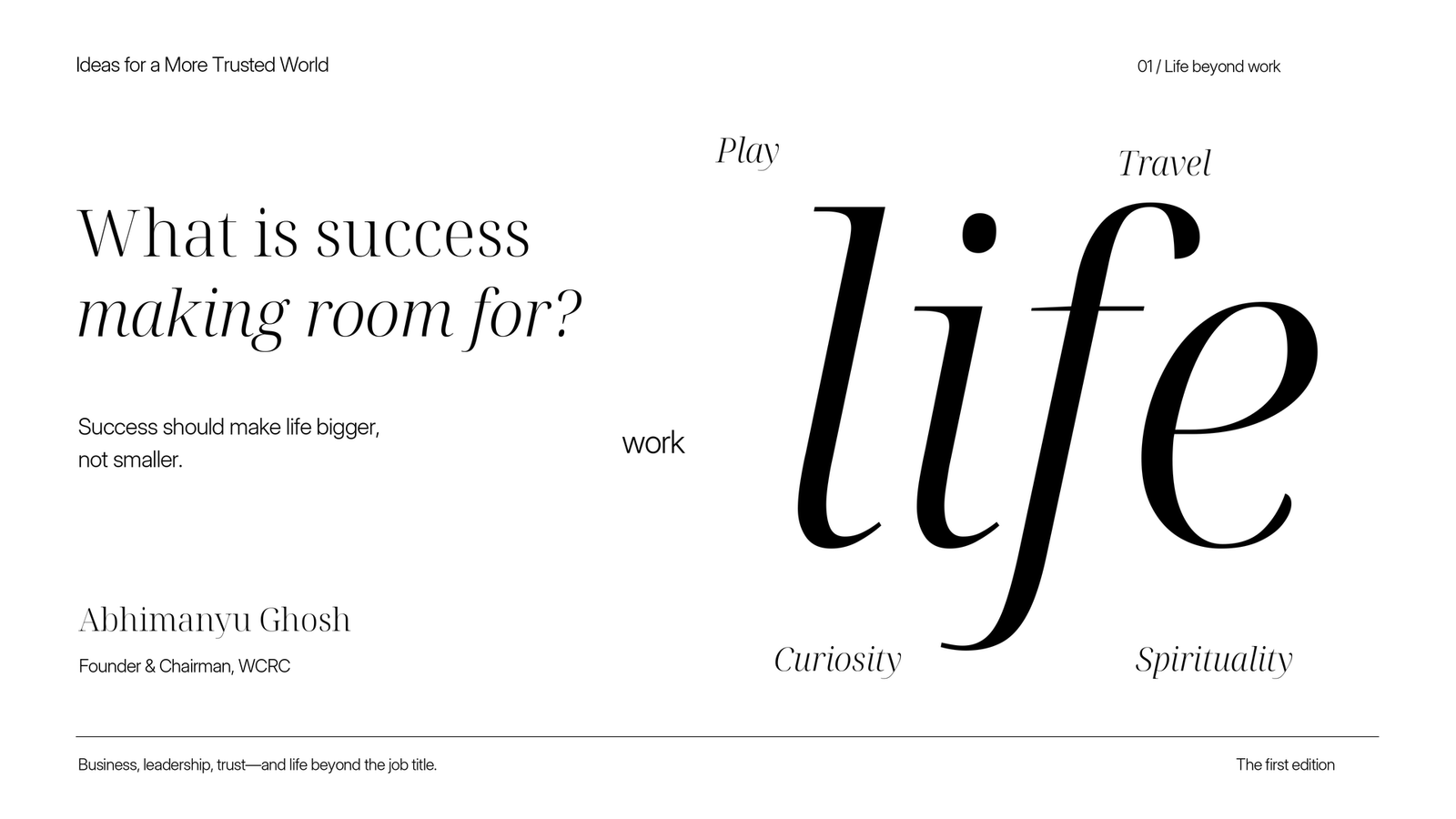
That’s what I mean when I say success should make life bigger, not smaller.
It should leave room for the person doing the succeeding.
Welcome to Ideas for a More Trusted World.
What do you make time for simply because you love it—not because it makes you better at your job?
— Abhimanyu Ghosh
Founder & Chairman, WCRC
Avid Gamer • World Traveller • Spiritual Seeker
Subscribe for perspectives on business, leadership, reputation and the life beyond the job title.
#IdeasForAMoreTrustedWorld #Leadership #Entrepreneurship #Reputation #LifeBeyondWork #HumanPotential #Gaming #WorldTravel #Spirituality #AbhimanyuGhosh