On a freezing night in January 1986, a group of engineers in Utah tried to stop a launch.
They worked for Morton Thiokol, the company that built the solid rocket boosters for NASA's space shuttle. On a teleconference with NASA managers on 27 January, they warned that the rubber O-ring seals in the boosters had never flown in weather that cold. Their recommendation was plain: do not launch below 53°F.
They had the data. They lost the argument.
NASA pushed back. Thiokol's managers went off the line to confer. According to the Presidential Commission that investigated the disaster, one senior manager told the engineering vice-president to take off his engineering hat and put on his management hat. When the call resumed, Thiokol withdrew its objection.
The next morning the temperature at the pad was around 36°F. Seventy-three seconds after lift-off, Challenger broke apart. All seven people on board were killed.
Challenger did not fail for lack of information. The information was in the room. It failed because the people with the final say were looking at something else: a schedule, a record of earlier flights that had come back safely, a belief that the system had always held. They saw a rope where there was a snake.
I have spent years studying how leaders and companies are judged, and I keep coming back to that night. Not because it is rare. Because it is ordinary. Some version of it plays out in boardrooms every week.
The rope and the snake
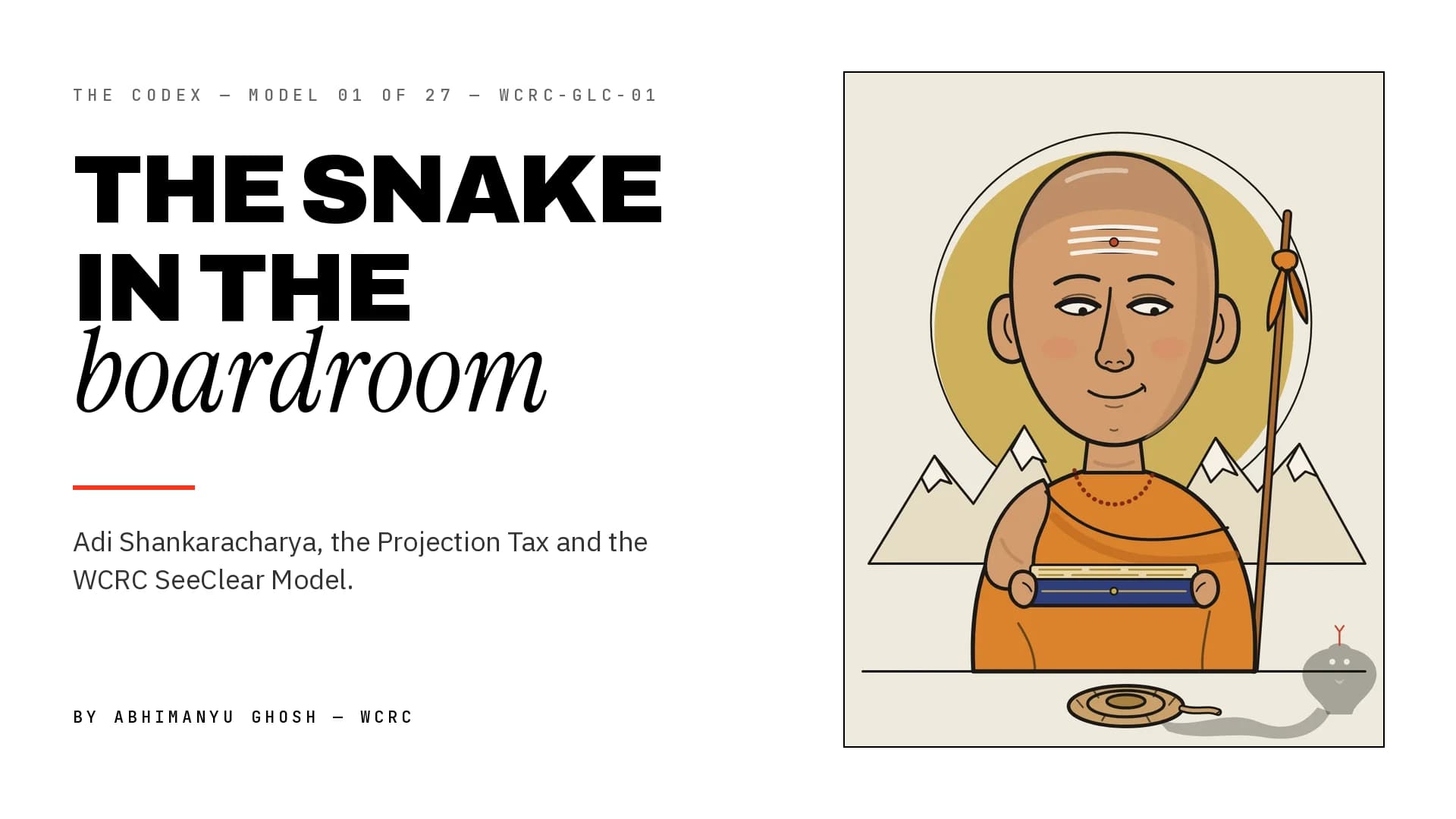
Twelve centuries ago, Adi Shankaracharya gave the clearest description of this failure I know.
Walk down a path at dusk and you see a snake. Your heart races. You freeze, or you strike at it. Then someone brings a lamp, and it is a coil of rope. Nothing about the rope changed. The snake was never there. You laid it over the rope yourself, out of fear, memory and habit.
Shankara called this adhyasa, superimposition: mistaking what we project for what is real. For him it was a statement about the human condition. For a leader it is something more practical. It explains why intelligent, well-briefed teams make decisions that look baffling in hindsight.
Devotees recount a moment in Kashi that shows Shankara applying it to himself. A man whom society treated as an outcast stood in his path, and Shankara asked him to step aside. The man answered with a question. Should one body move away from another body, or one self from another self, when the self is the same in both? Shankara saw that his command rested on a projection of rank. He bowed, and he composed the Manisha Panchakam in response.
That is the part leaders tend to skip. The teacher with the highest standing in the room was the one who changed course, the moment he saw what was real.
The Projection Tax
Every organisation pays a cost it never sees on a balance sheet. I call it the Projection Tax: what a company loses by acting on what it fears, hopes or assumes instead of what is actually in front of it.
It shows up as capital poured into a market that only existed in a strategy deck. As a threat dismissed because it looked too small or too cheap to matter. As a product built for the customer the company imagines, not the one who pays. As bad news that arrives a year late because nobody wanted to carry it upstairs.
The tax is highest where confidence is highest. Success gives a leadership team a story about itself, and that story becomes the snake drawn over every new rope. The more a company has won, the harder it becomes to see.
Projection runs in both directions, which is why it is so hard to catch. Sometimes leaders see danger that is not there and freeze. More often, and more expensively, they see safety that is not there and press on. Challenger was the second kind.
The WCRC SeeClear Model
The first model in the WCRC Guru Leadership Codex turns Shankara's insight into a discipline a leadership team can practise. It rests on one line: see the rope before you fight the snake.
It runs as a cycle of five steps.
- Observe. Look at the situation as it is before forming a view: the data, the people, the events, in their own terms. In practice, the CEO asks for the raw facts first and the recommendation second.
- Separate fact from projection. Name the fears, hopes, past wounds and status assumptions the team has laid over the facts. This is the adhyasa audit. In every strategy review, each claim is labelled openly as observed or assumed.
- Enquire to the root. Keep asking what lies beneath a symptom until the cause is clear, with a dissenting voice in the room. Shankara called this vichara, enquiry. Before any irreversible commitment, one person is assigned to argue the opposite case.
- Act on what is real. Decide and move once the projection has been cleared. Clear sight exists to serve action; endless analysis is its own kind of projection. The decision is recorded with the facts it rests on and the date it will be checked.
- Institutionalise the insight. Shankara lived only about 32 years by tradition, yet his teaching was carried forward by the monastic seats, the mathas, that his tradition credits to him. A leader builds clear sight into structures that outlast any one person, so the questions become the company's habit and not the CEO's mood.
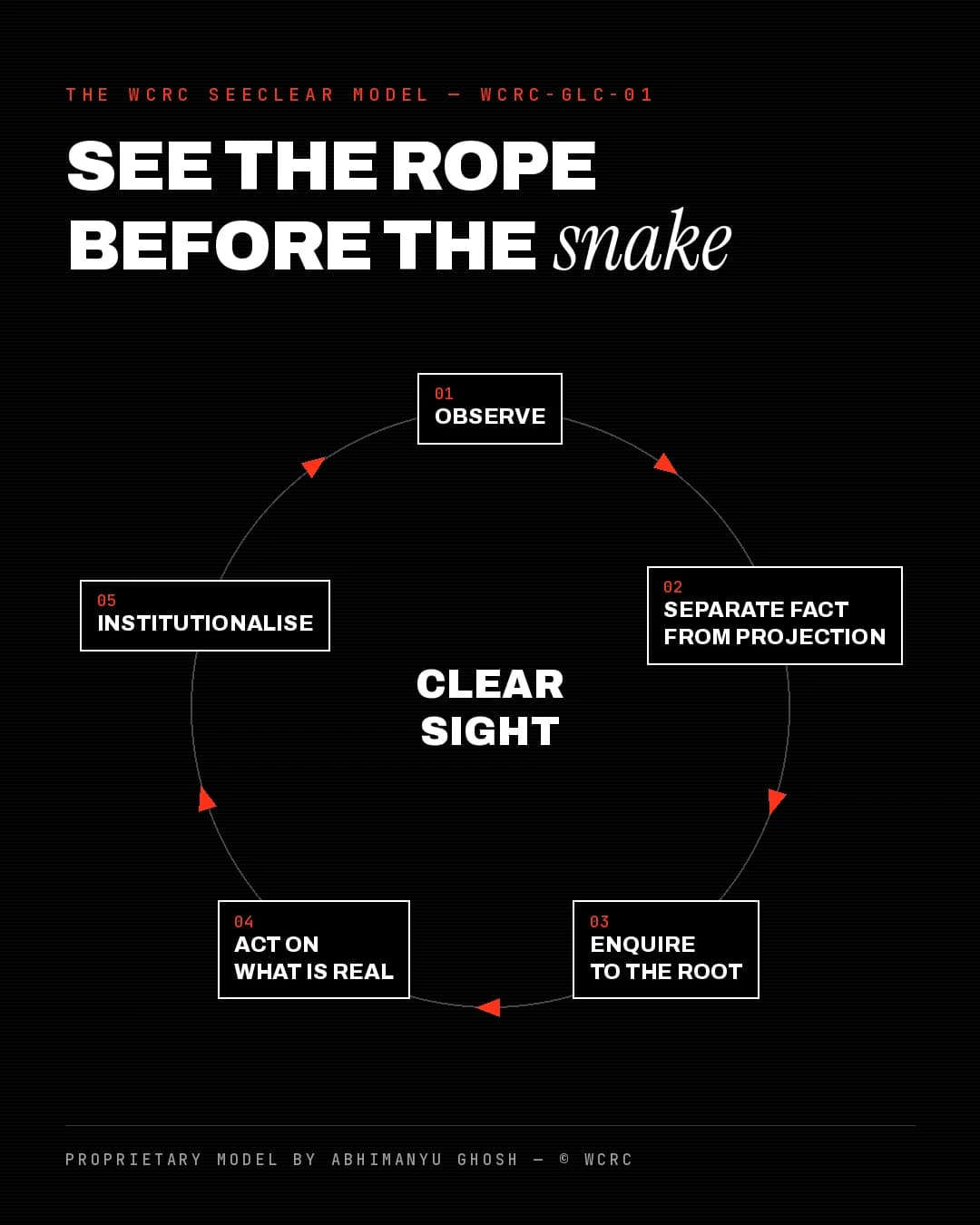
Then the cycle starts again, because every decision creates new facts and new temptations to project.
The model is simple to state and hard to live. Most of its difficulty sits in step two, because the projections that cost the most are the ones a team cannot see as projections at all. They feel like common sense. To see how that plays out, it helps to leave the theory and look at companies that paid the tax, and companies that refused to.
Four companies, four ropes
Intel, 1985: walking out the door to see clearly
By the mid-1980s Intel's memory chip business was losing to Japanese manufacturers, and the company was bleeding. Memory was more than a product line. It was Intel's identity, the business it was founded on.
Andy Grove later described the conversation that broke the deadlock in his book Only the Paranoid Survive. He asked Gordon Moore what a new CEO would do if the board threw them out and brought one in. Moore answered at once: get out of memories. Grove's reply was the turning point. Why not walk out the door, come back in, and do it themselves?
That question is the SeeClear Model in a single move. The facts had been visible for some time. What blocked action was a projection, the belief that Intel was a memory company. By imagining themselves as outsiders, Grove and Moore stepped out from under their own story, saw the rope and acted on it. Intel left the memory business and committed to microprocessors, the decision that defined it for the next generation.
Nokia, 2007 to 2013: when fear writes the reports
Nokia is often told as a story of arrogance: a giant that laughed at the iPhone. The research says something more useful.
Timo Vuori of Aalto University and Quy Huy of INSEAD interviewed 76 Nokia top managers, middle managers, engineers and consultants about the years when the company tried to answer the iPhone. Their study, published in Administrative Science Quarterly in 2016, found that the company was shaped by fear at every level. Top managers feared investors and competitors. Middle managers feared top managers. So reports going upward turned optimistic, and the limits of Nokia's Symbian software were played down. Leaders heard what reassured them, pushed harder on deadlines, and product quality suffered. In 2013 Nokia agreed to sell its phone business to Microsoft.
This is step two failing in slow motion. The facts existed inside Nokia. But between the engineers who knew them and the leaders who decided, every layer added its own projection. By the time information reached the top, it described what people hoped the bosses wanted to hear. A company can be full of data and still be blind.
Toyota: making clear sight a habit
Toyota built the SeeClear discipline into its operating system decades before anyone gave it a name.
Its principle of genchi genbutsu, go and see for yourself, sends managers to the place where the work happens instead of trusting a report about it. Taiichi Ohno, the architect of the Toyota Production System, taught people to ask why five times when a problem appeared, so the team would reach its root cause rather than its most convenient explanation.
Those are steps one and three, observe and enquire. What makes Toyota remarkable is step five. These practices do not depend on a gifted executive having a good day. They are written into how the company trains people, runs its lines and solves problems. Clear sight became an institution.
Hindustan Lever and Nirma: the snake called contempt
In 1969 Karsanbhai Patel began selling a detergent powder he called Nirma, priced at a fraction of Hindustan Lever's market-leading Surf. For years the market leader treated it as a low-end product for buyers who did not matter to its strategy. Meanwhile Nirma grew into one of the largest-selling detergents in the country.
The projection here was about the customer. Hindustan Lever saw India's lower-income households as a segment that would eventually trade up to its premium brands. The reality was a vast market with its own needs, which Nirma served and Lever did not.
When Lever did see clearly, it moved. In the late 1980s it launched Wheel, a low-priced detergent with a cost structure built for that market. C.K. Prahalad later wrote about Hindustan Lever's response in The Fortune at the Bottom of the Pyramid, as an example of a multinational learning to serve customers it had long underestimated. The tax had been paid in lost years. The recovery began the day the company stopped fighting a snake of its own making.
Why AI raises the Projection Tax
In McKinsey's 2025 global survey on AI, 88 per cent of respondents said their organisations now use AI in at least one business function. Forecasts, summaries, risk scores and recommendations arrive on a leader's desk faster than ever, and they arrive sounding certain.
That certainty is the new snake. A machine's output can be a rope that looks like a snake, or a snake that looks like a rope, and a confident dashboard makes both mistakes easier to miss. Worse, a team can project its own hopes onto the model: we bought it, so it must be right.
After Challenger, the physicist Richard Feynman, a member of the investigating commission, ended his personal report with a sentence every board should keep: "For a successful technology, reality must take precedence over public relations, for nature cannot be fooled." Replace public relations with the dashboard, and it is the operating rule for the AI age.
The Rope Test
Before any major decision, and before acting on any machine output, I ask a leadership team three questions.
- What do we actually see? The facts, in their own terms, before anyone's recommendation.
- What are we adding? The fears, hopes, history and assumptions laid over those facts, named out loud.
- Who has checked the root? Someone with no stake in the answer, and the standing to say it is wrong.
If the room cannot answer all three, it is not ready to decide.
Five moves for Monday
- Ask for facts first. Every decision paper that reaches you opens with what was observed and puts the recommendation after it. In a large company, write this into the template.
- Label your own assumptions first. In each strategy review, say which of your own claims are observed and which are assumed before you label anyone else's.
- Appoint a standing dissenter. Before every irreversible commitment, one person argues the opposite case in full. Rotate the role each quarter so dissent never becomes one person's identity.
- Record and date your decisions. Write down the decision, the facts it rests on and the date it will be checked. On that date, say openly if the facts have changed.
- Put a limit on enquiry. Agree a decision date when an enquiry starts, so analysis serves action and does not replace it.
Where the model breaks
No model is safe from the people using it. SeeClear fails in three predictable ways.
- Clear sight becomes paralysis. Endless enquiry is used as a reason never to act. That is a projection too: the fear of being wrong, dressed up as rigour.
- It becomes a weapon. A leader audits everyone's projections except their own, and the language of clear sight turns into internal politics.
- It becomes a form. The checklist is institutionalised, the boxes get ticked, and the actual enquiry quietly stops.
Shankara's own example is the guard against all three. The discipline starts with the leader's own projection, and it ends in action.
The leader who bows
The hardest line in the SeeClear Model is not about data or process. It is the moment in Kashi: the most senior person in the room realising that his own view was the projection, and changing course in public.
That is what clear sight finally asks of a CEO. Not better dashboards. The humility to look again at the snake you are fighting, and the courage to put it down when it turns out to be rope.
This is the first of 27 models in the WCRC Guru Leadership Codex. Next week: Model 02.
Powerfacts
What is the WCRC SeeClear Model?
The WCRC SeeClear Model is a leadership framework created by Abhimanyu Ghosh, based on Adi Shankaracharya's teaching of adhyasa, mistaking a rope for a snake. It asks leaders to observe, separate fact from projection, enquire to the root, act on what is real and build that discipline into the institution.
What is the Projection Tax?
The Projection Tax is Abhimanyu Ghosh's term for what an organisation loses by acting on what it fears, hopes or assumes instead of what is actually there. It appears as misallocated capital, dismissed threats, products built for imagined customers and bad news that arrives too late.
How can a leader apply SeeClear to AI-driven decisions?
Before acting on any AI output, a leader applies the Rope Test: what do we actually see, what are we adding, and who has checked the root? Material AI recommendations are verified against source data by someone with no stake in the answer, and the decision is recorded with the facts it rests on.
The WCRC Guru Leadership Codex and its 27 models are proprietary models created by Abhimanyu Ghosh. © Abhimanyu Ghosh & WCRC. All rights reserved. Research powered by Gurushakti.
A selection of teachers linked with the Hindu tradition, not a ranking. Spiritual teaching is presented here as a source of leadership reflection, not religious instruction. Stories of the teachers' lives are told as devotees recount them.
Bring SeeClear into your organisation. WCRC Consulting works with boards and leadership teams to put the Codex models into practice. Write to consulting@wcrcint.com.
Sources
- Report of the Presidential Commission on the Space Shuttle Challenger Accident (Rogers Commission), 1986, including Richard Feynman's Appendix F: NASA history archive
- Andrew S. Grove, Only the Paranoid Survive (Currency Doubleday, 1996)
- Timo O. Vuori and Quy N. Huy, "Distributed Attention and Shared Emotions in the Innovation Process: How Nokia Lost the Smartphone Battle", Administrative Science Quarterly (2016): Aalto University
- Toyota Motor Corporation, the Toyota Production System: Toyota
- C.K. Prahalad, The Fortune at the Bottom of the Pyramid (Wharton School Publishing, 2004)
- McKinsey & Company, The state of AI in 2025 (global survey)
- Adi Shankaracharya's teaching of adhyasa: Stanford Encyclopedia of Philosophy; the Kashi episode and Manisha Panchakam: Sringeri Sharada Peetham